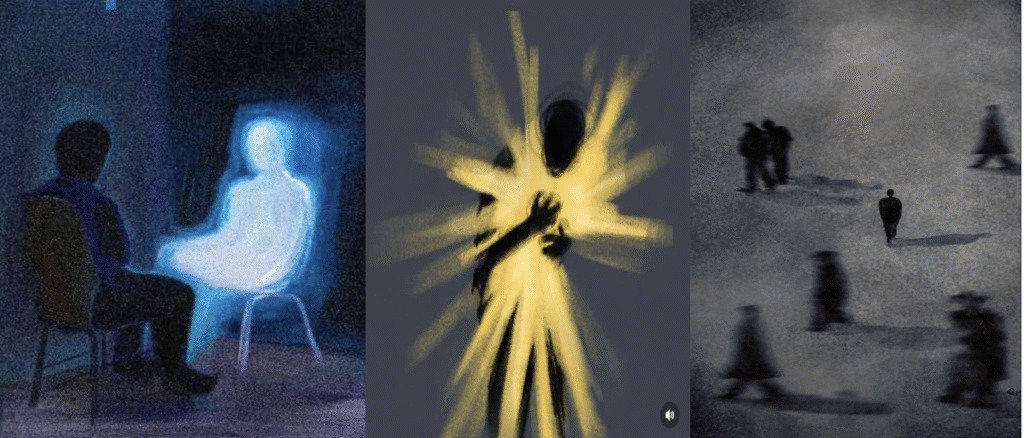
“Final”
The Last Time I Heard Your Voice
Walking through the cold house takes me back to that moment when the sound of ambulances echoed through the entire neighborhood. Neighbors came out to look, trying to hide behind their curtains, but their shadows betrayed them. That day was bright and sunny, and I could feel the rays of light touching my skin—yet the air felt heavy with something different, something I didn’t know how to name. It was a day I will never forget: a day when time, voices, and decisions changed a world… and took a life away. It was February 4th, and the whole country trembled between fear and hope—elections, voices in the streets, promises of change. While Ecuadorians decided the future of the nation, all I could think was that such a sunny day should not have ended this way. The feeling ran through my bones, as if my memories and hopes were fading away—like a flower wilting as its last petal falls.
My grandfather had been one of the most important people in my life—and also one of those who would take a part of me with him when he left. For me, talking about him is like trying to describe the warmth of a sunrise: impossible to capture completely. He was a man whose energy filled the entire house. He loved turning on his radio, sitting on his small bed, and singing with his eyes closed. Moreover, he always made me laugh with his favorite phrase: “Mijita, come, sit with me and sing to your old man.” The song we always sang together was “En vida.” He would hum softly, “na, na, na, na,” while I, with my small voice, followed the lyrics: “En vida que me quisieras, de muerto ya para qué.” In those moments, I felt like the most beautiful artist in the world. To my grandfather, my mom was “the apple of his eye.” He loved her with such tenderness that it could be felt in the air every time he looked at her. However, little by little, those moments began to fade away. The illness started to take him—silent but constant. Diabetes—this deceiving illness—began to dim the light that once made our home feel warm. When we received the diagnosis, it felt as if the world had stopped for a moment. No one wanted to accept it, but deep down, I knew that something inside me was beginning to change too. As a result, our routine changed completely, especially my mom’s and mine. She became more serious; in her eyes, I could see the pain she felt watching her father fall ill. Her life became busier, and there was hardly any time left to see the smile that had always accompanied her. Gradually, the illness consumed him. First, he stopped eating. Then his kidneys stopped working. And finally, the disease took away his brown eyes—the ones that had always looked at me with such love. When he lost his sight, it was an unbearable blow for my mother and grandmother. Nevertheless, even though he could no longer see us, he never stopped recognizing us; hearing our voices was enough for him to know who was there. I remember the day I learned he had lost his sight—it felt as if my soul had shattered into a thousand pieces. I thought time was turning against me, that every minute was taking him away faster. His eyes could no longer find mine, but his voice, his essence, and his love still recognized me, even as the months went by. Eventually, his condition kept getting worse, so the doctors decided to hospitalize him to see if they could control it with dialysis. He spent his days in that hospital that smelled of medicine and white coats, while his essence slowly faded away. By then, he no longer had the strength to sing—or even to hum the song he love reminded him of his granddaughter.
It was the day to go vote—and, at the same time, the day to return to the home we had longed for so much. The day before, my grandfather José had finally left that cold place filled with the smell of medicine, where illness slowly dimmed the light of every patient. That night, he spoke to my mom with a voice full of frustration and said, “Mariana, take me home. I don’t want to be here anymore.” His tone sounded like that of a child complaining when something does not go their way. When we arrived at the house that had once been full of life, everything was dark, carrying a heavy sense of abandonment. As soon as he stepped inside, his first words were, “Mija, don’t leave. Stay with me.” I remember those six words as if they were engraved in my mind. Later, my mom went to vote, and after that, we took the bus to my grandfather’s house. Meanwhile, the hours passed as if time were running away: 11, 12, 1, 2. By the time we arrived around 2:30, every minute felt numbered, and we all knew this day would be remembered forever. At first, when we saw him lying there from a distance, he looked like a child sleeping peacefully. However, as we got closer, we noticed he was sweating cold. In that moment, my life changed—the moment I saw my grandfather die before my eyes. Immediately, my mother’s desperation became indescribable; she wanted to hear him say he was okay, but his breathing weakened, and his heart slowly faded away. As a result, we called 911, and the operator guided us through the first aid steps. Meanwhile, my heart felt as if it were going to burst out of my chest, and the sweat from my nerves fell to the floor like shattered glass. Soon after, the paramedics arrived, and the sound of the ambulance was so loud that even the dogs began to cry. For seven minutes, they did everything they could to save him. During that time, I knelt beside him, fully aware that if he died, he would take a part of me with him. In the eighth minute, the paramedics pronounced him dead. At that instant, my world shattered into a thousand pieces, and I felt as if a thousand needles pierced my heart. I cried and begged them not to take him away, not to let him go. My screams filled the silence of the room, and even the paramedics shed tears as they witnessed my despair. I do not remember how long I remained beside him. Eventually, when the morgue arrived, I knew they would take him to a cold, colorless place where he would no longer be able to sing or open his brown eyes. Although I begged the men not to separate us, deep down, I knew it was inevitable, that moment had come—and that his essence would stay with me forever.
My grandfather’s death changed my life profoundly, to the point that my grades began to drop. At first, no one seemed to understand the pain in my heart or the feeling that the silence was slowly consuming me. Although my mom knew what I was going through, it was even harder to accept that I had lost my grandfather while she had lost her father. Seeing that I was no longer the same child, she decided to take me to a psychologist. During my sessions, I told him everything I was experiencing, and he helped me reflect on many things. He once told me a phrase that has stayed with me my whole life: “People come into this world to fulfill a mission, and when they complete it, they have to leave, because more people need them.” Even now, it still hurts to talk about him, but I know he is in a better place. Moreover, I remember that he would want us to celebrate his life with joy and for my tears to run down my cheeks filled with happiness, not with pain.
Thinking that a person can change the way I see the world is truly remarkable, and this experience has left a deep mark on me. Since then, I have grown as a person, and the essence of his brightness is still present within me. I have learned thatyou have to let them go in order to find peace. Moreover, remembering is not bad; it is actually good. It allows me to relive the important moments I shared with him, especially the ones that shaped my relationship with him. I’m certain that if he could see me now, he would be proud of his granddaughter, because even though he is no longer here, I have been able to stay strong. Ultimately, the greatest lesson of my life is learning to love until the very last breath and the very last minute that person gives you.

This entry is licensed under a Creative Commons Attribution-NonCommercial-ShareAlike 4.0 International license.

